


Fall 2026 Winner of the Hope for Humanity Scholarship
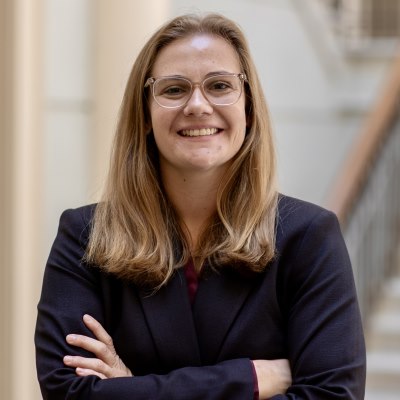
Victoria Wiggin
A 2L at Regent University, Victoria Wiggin has spent years working alongside trafficking survivors through Latisha’s House, Safe House Project, and the Center for Global Justice. She has also supported legislative efforts in Virginia that help survivors access services and clear records tied to their victimization. The Estevez Group is honored to support a student who is already making a difference.
Read Their Essay Here:
“You can choose to look away, but you can never again say that you did not know.” These words, spoken by a British abolitionist, William Wilberforce, in the late 1700s hit me like a ton of bricks when it flashed across the screen of the documentary Nefarious in 2011. I was in 10th grade.
While I have been tangentially involved in the anti-trafficking world since I turned 18, my involvement in the last six or so years has really picked up. I have volunteered with the following organizations: Safe House Project, a national anti-trafficking organization; Latisha’s House, a transitional housing program for women coming out of the life of trafficking; the Virginia Coalition Against Human Trafficking (“VCAHT”), a non-profit lobbying organization in Virginia that helps write and garner support for legislation that makes it easier for trafficking victims to gain access to victim services and vacate their records of crimes committed as a direct result of their victimization; and the Center for Global Justice (“the Center”), an organization attached to Regent University that works locally and internationally to draw attention to human rights violations and lend tangible support to the efforts to stop these atrocities.
My role at Latisha’s House was self-created. For reasons my word limit will not allow me to elaborate on, I taught a boxing/grappling class. This was expressly not a “self-defense” class. I taught a combatives class. It was designed to be 6-weeks, and it lasted for almost a year. The only reason I had to stop was because I went to law school. I will teach again once my schedule permits.
Since working with the women at Latisha’s House, the Center, and VCAHT, I have been made aware of systematic changes that need to happen in Virginia to help victims of trafficking get the resources they need. When I am an attorney, I will dedicate significant portions of my time to victim services and assisting trafficking victims get the wrap-around services they need. This will require systematic change, but change that is being incrementally introduced in other regions. My main focus will be to bring a model like Ohio’s CATCH Court: a specialized docket designed not to punish trafficking victims but create for them a path towards recovery, healing, and support with a wrap-around approach employing a multidisciplinary team to hold each participant accountable. Virginia’s Recovery Court is a specialized docket that is already established and creates a working framework from which a specialized docket for prostitution can arise. While not all trafficking is under the umbrella of prostitution, the overlap is enormous. There would be a set list of requirements to complete the program (sobriety, attaining a job, getting stable housing, not violating any probation, etc.) that the wrap-around services are all designed to assist with and then, at completion of the program, all relevant charges would be dropped. The accountability from the court and the involved non-profits will gradually loosen as the participant successfully moves through the program. This concept is not new, only the application.
My focus in school is to impact lives individually as more trafficking victims take advantage of Virginia’s vacatur law. As an attorney, the change I hope to create will be systematic in a way that helps to offload the criminal docket and leads to the drop in recidivism from 80% to 18% advertised by the CATCH Court in Ohio. 1